
How PrepYourWeek calculates nutrition
Every recipe is built from structured ingredients and quantities. Those ingredients are mapped to food-composition data from sources including BLS 4.0 and USDA FoodData Central, and the nutrition you see is calculated from them.
Data-backed nutrition
- 15,000+
- Reference foodsReference foods
- 1.1M+
- Nutrient datapointsNutrient datapoints
- 141
- Nutrient types supportedNutrient types
- 100%
- Active recipe ingredients mappedIngredients mapped
From ingredient to nutrition per serving
Nutrition is calculated from the recipe's structured ingredients and quantities instead of manually assigning macros to each recipe.
Recipe ingredient
A structured ingredient with a quantity, e.g. sushi rice, uncooked.
Ingredient mapping
The PrepYourWeek ingredient is linked to an appropriate food record in the nutrition database.
Nutrient values
Standardized nutrient values are retrieved for the reference quantity, typically per 100 g.
Recipe quantity
The values are scaled to the actual amount of the ingredient used in the recipe.
Whole-recipe nutrition
Nutrition from all ingredients is combined.
Per serving
The complete recipe nutrition is divided according to the recipe's serving count.
Where the nutrition data comes from
Three standardized reference datasets, imported and maintained as the basis for every calculation.
Bundeslebensmittelschlüssel (BLS 4.0)
Max Rubner-Institut · Germany
7,140 reference foods imported
Germany's national food-composition database. PrepYourWeek uses BLS data as one of its primary nutrition reference sources.
7,140reference foods imported
USDA FoodData Central — Foundation Foods
U.S. Department of Agriculture
469 reference foods imported
Detailed food-composition data provided through USDA FoodData Central, including analytical nutrient information for foundational foods.
469reference foods imported
USDA FoodData Central — SR Legacy
U.S. Department of Agriculture
7,793 reference foods imported
The USDA Standard Reference legacy dataset, used as an additional source of established food-composition values.
7,793reference foods imported
More than calories and macros
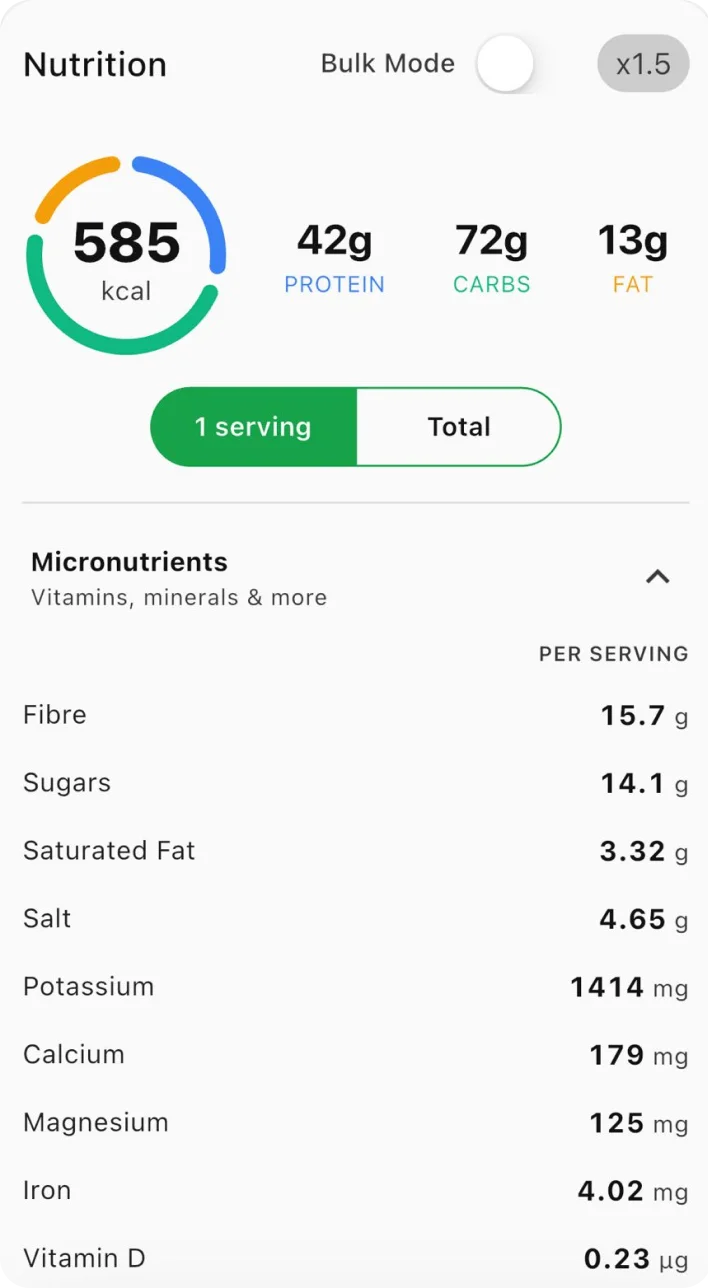
PrepYourWeek's nutrition model supports 141 nutrient types across 8 categories. Calories, protein, carbohydrates and fat are only the beginning — the underlying model can also represent vitamins, minerals, fatty acids, amino acids and fibre components.
CaloriesProteinFatCarbohydratesFibreSugarsSodium
Shown across PrepYourWeek recipes
- 6
Macronutrients
Energy (kilojoule) · Energy · Water · Protein · Fat
- 22
Carbohydrates & Fiber
Fibre · Sugar Alcohols · Mannitol · Sorbitol · Xylitol
- 29
Vitamins
Vitamin A (Retinol Equivalents) · Vitamin A (RAE) · Retinol · Beta-Carotene · Other Carotenoids
- 17
Minerals
Salt · Sodium · Chloride · Potassium · Calcium
- 38
Fats & Fatty Acids
Saturated Fat · Butyric Acid (C4:0) · Caproic Acid (C6:0) · Caprylic Acid (C8:0) · Capric Acid (C10:0)
- 19
Amino Acids
Essential Amino Acids · Alanine · Arginine · Aspartic Acid · Cysteine
- 6
Organic Acids
Organic Acids · Acetic Acid · Citric Acid · Lactic Acid · Malic Acid
- 4
Other Nutrients
Alcohol · Ash · Nitrogen · Caffeine
View all 141 nutrient types
6Macronutrients
- Energy (kilojoule)
- Energy
- Water
- Protein
- Fat
- Carbohydrates
22Carbohydrates & Fiber
- Fibre
- Sugar Alcohols
- Mannitol
- Sorbitol
- Xylitol
- Monosaccharides
- Glucose
- Fructose
- Galactose
- Disaccharides
- Sucrose
- Maltose
- Lactose
- Sugars
- Oligosaccharides
- Starch
- Low-Molecular-Weight Fiber
- High-Molecular-Weight Fiber
- Insoluble Fiber
- Soluble Fiber
- Soluble High-Molecular-Weight Fiber
- Insoluble High-Molecular-Weight Fiber
29Vitamins
- Vitamin A (Retinol Equivalents)
- Vitamin A (RAE)
- Retinol
- Beta-Carotene
- Other Carotenoids
- Vitamin D
- Vitamin D3
- Vitamin D2
- Vitamin E
- Alpha-Tocopherol
- Beta-Tocopherol
- Gamma-Tocopherol
- Delta-Tocopherol
- Alpha-Tocotrienol
- Vitamin K
- Vitamin K1
- Vitamin K2
- Vitamin B1 (Thiamine)
- Vitamin B2 (Riboflavin)
- Niacin Equivalents
- Vitamin B3 (Niacin)
- Vitamin B5 (Pantothenic Acid)
- Vitamin B6
- Vitamin B7 (Biotin)
- Folate equivalent
- Folate
- Folic Acid
- Vitamin B12
- Vitamin C
17Minerals
- Salt
- Sodium
- Chloride
- Potassium
- Calcium
- Magnesium
- Phosphorus
- Sulphur
- Iron
- Zinc
- Iodine
- Copper
- Manganese
- Fluoride
- Chromium
- Molybdenum
- Selenium
38Fats & Fatty Acids
- Saturated Fat
- Butyric Acid (C4:0)
- Caproic Acid (C6:0)
- Caprylic Acid (C8:0)
- Capric Acid (C10:0)
- Lauric Acid (C12:0)
- Myristic Acid (C14:0)
- Pentadecylic Acid (C15:0)
- Palmitic Acid (C16:0)
- Margaric Acid (C17:0)
- Stearic Acid (C18:0)
- Arachidic Acid (C20:0)
- Behenic Acid (C22:0)
- Lignoceric Acid (C24:0)
- Monounsaturated Fat
- Myristoleic Acid (C14:1)
- Palmitoleic Acid (C16:1)
- Vaccenic Acid (C18:1)
- Oleic Acid (C18:1)
- Gondoic Acid (C20:1)
- Erucic Acid (C22:1)
- Polyunsaturated Fat
- Omega-3 Fatty Acids
- Alpha-Linolenic Acid (ALA)
- Stearidonic Acid
- Eicosapentaenoic Acid (EPA)
- Docosapentaenoic Acid (DPA)
- Docosahexaenoic Acid (DHA)
- Omega-6 Fatty Acids
- Linoleic Acid
- Conjugated Linoleic Acid (CLA)
- Gamma-Linolenic Acid (GLA)
- Eicosadienoic Acid
- Dihomo-Gamma-Linolenic Acid (DGLA)
- Arachidonic Acid
- Other Fatty Acids
- Cholesterol
- Trans Fat
19Amino Acids
- Essential Amino Acids
- Alanine
- Arginine
- Aspartic Acid
- Cysteine
- Glutamic Acid
- Glycine
- Histidine
- Isoleucine
- Leucine
- Lysine
- Methionine
- Phenylalanine
- Proline
- Serine
- Threonine
- Tryptophan
- Tyrosine
- Valine
6Organic Acids
- Organic Acids
- Acetic Acid
- Citric Acid
- Lactic Acid
- Malic Acid
- Tartaric Acid
4Other Nutrients
- Alcohol
- Ash
- Nitrogen
- Caffeine
All exported nutrient names are listed below by category.
Individual nutrient availability varies by reference food and source dataset — not every BLS or USDA food carries a measurement for every nutrient.
How recipe nutrition is calculated
PrepYourWeek starts with nutrition per 100 g, scales it to the amount actually used, then combines everything and divides it by the number of servings.
Reference data
Each mapped food provides nutrient values, usually per 100 g.
Nutrition valuesper 100 g
Recipe quantity
The reference values are scaled to the amount actually used.
100 g reference300 g used× 3
Whole recipe
Nutrition from all ingredients is added together.
Ingredient 1+ Ingredient 2+ Ingredient 3 …= Whole recipe
Per serving
The whole-recipe nutrition is divided by the recipe's defined serving count.
Whole recipe÷ servings= nutrition per serving
Calculated from quantities, not guessed per recipe.
Why nutrition values can still vary
Nutrition values in PrepYourWeek are calculated estimates, derived from reference food-composition data and the quantities in each recipe. Real-world values vary for ordinary reasons.
Data-backed does not mean laboratory-tested.
PrepYourWeek uses structured reference data to make nutrition calculations consistent and traceable, but individual foods and prepared meals naturally vary.
- Brand and product differences
- Natural variation between foods
- Growing conditions and cultivar
- Preparation method
- Cooking-related water loss or gain
- Ingredient substitutions
- Actual portion size
Questions about the numbers
Is PrepYourWeek nutrition lab tested?
No. Nutrition is calculated from structured ingredient quantities and food-composition reference data rather than laboratory analysis of each finished meal.
Are the nutrition values exact?
No food-composition calculation can guarantee the exact nutrient content of an individual prepared meal. Foods naturally vary. PrepYourWeek provides calculated values based on structured reference data and recipe quantities.
Where does PrepYourWeek get nutrition data?
Primarily from BLS 4.0 and USDA FoodData Central datasets including Foundation Foods and SR Legacy.
How is an ingredient matched to nutrition data?
PrepYourWeek ingredients are mapped to appropriate reference foods in the nutrition database. The associated nutrient profile is then used when calculating recipes.
How is nutrition per serving calculated?
Ingredient nutrition is calculated according to the quantity used, combined for the full recipe, and divided by the defined number of servings.
Why is this better than manually entering macros?
It creates a repeatable and traceable calculation process based on structured ingredient data rather than entering standalone nutrition values for each recipe.
Data sources & attribution
Reference datasets used in PrepYourWeek nutrition calculations.
See data-backed nutrition
in every recipe
Explore PrepYourWeek recipes and plan your week with nutrition calculated directly from the ingredients used.